

Today Iris comes out of stealth. It's a financial network that lets telecom operators earn on the infrastructure they already own. VIVA, a licensed carrier in Bolivia, is the first operator live on it. Here's why we built it.
Every tech company success story you can name from the last twenty years reached its customers over infrastructure it did not build.
Search, social, advertising, streaming, marketplaces, cloud, payments, financial services. Every one of them found its first hundred million users across networks that telecom operators spent decades and staggering amounts of capital putting in the ground. The towers. The fiber. The spectrum licenses. The retail footprint in towns with no bank branch. The SIM in a verified customer's pocket, tied to a billing relationship the operator has maintained for years.
This is the most valuable distribution and identity network ever assembled. It was built by operators, and the businesses built on top of it captured most of the economics it made possible.
So what can the telecom operators do to take back the economics of the networks they built?
Who does the network work for?
Operators monetized connectivity because connectivity was easy to bill for. Rating engines, interconnect settlement, roaming agreements, prepaid top-up all easily quantifiable by tracking how much a person consumed. It is extraordinary financial machinery. It clears billions of transactions a day at a reliability rate that most banks would envy.
It just answers one question and does it well. But business models evolved.
The companies operating on top of the network built their machinery around different questions. Who is this person? What are they likely to buy? What will they pay for, on credit, in this currency, today? Every one of those answers is assembled from identity, billing history, distribution and customer relationships, and the operator holds better raw material for all of it than the tech platforms using their networks do.
The gap is not in assets. It’s not in distribution. It’s not in data. On all of these, the mobile operators win hands down. The gap is in the right infrastructure to offer something besides a meter. They have inputs and no product to sell them through, no settlement layer to clear the resulting value, and no way to try any of it without opening systems that cannot go down. The gap is in converting from pipe to platform.
Can “Telco to Techco” be a reality? (finally)
Traffic across these networks has grown by an order of magnitude that has no precedent in any other industry. Operator service revenue has not grown with it. Volume has exploded, but their economics stayed flat.
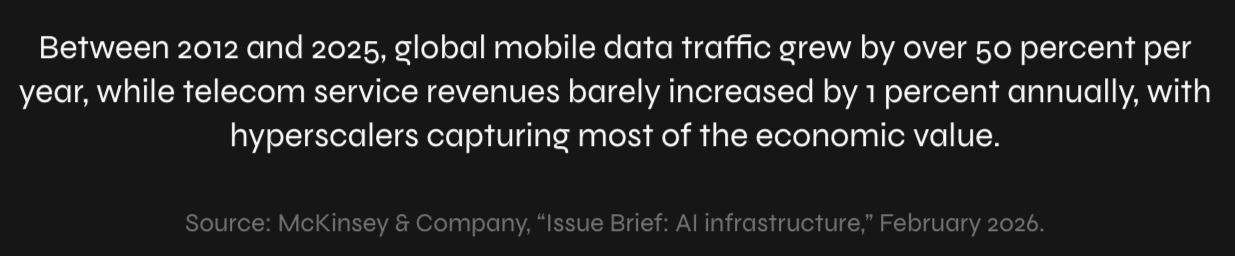
Every operator leader I talk to already knows this. Most have a document about it. "Telco to techco" has been said from conference stages since at least 2019. But it hasn’t actually happened.
What has been missing is not ambition or awareness. It is a way to act that does not require an operator to become a software company, replace its core, or spend three years and a nine-figure budget finding out whether the thesis was right.
Iris is the missing link
Iris is a financial network for telecom operators.
They connect their existing identity, billing, and distribution and switch on revenue modules, from advertising to settlement. Everything settles in dollars through USDi, a dollar-backed stablecoin. Nothing volatile touches the balance sheet, and it’s private yet transparent. Iris runs the rails. Operators keep the economics.
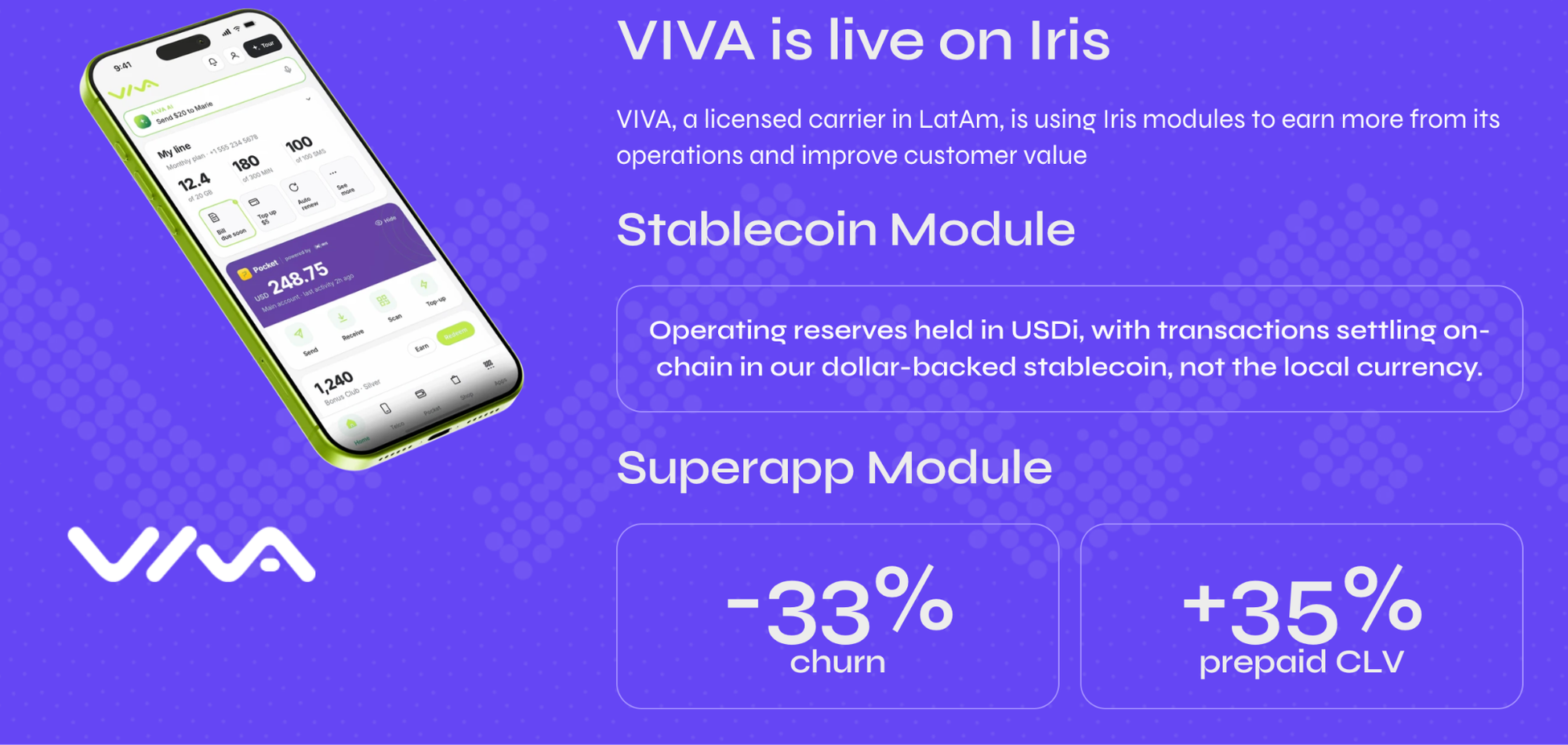
For example, our Superapp Module turns everyday subscriber activity into advertising, payments and commerce revenue. With the Stablecoin Module, value settles across the network in USDi, a dollar-backed stablecoin, so money moves and rests in dollars instead of local currency.
The ambition is larger than any single module: an operator that participates in the economics its own infrastructure already creates.
This is no longer a thesis
Viva, a licensed mobile operator in Bolivia and Mexico, is the first carrier live on Iris. With Iris’s Stablecoin Module, it settles transactions and holds operating reserves in USDi, which means value sits in dollars rather than local currency. With the Superapp Module, it has reduced prepaid customer churn by 33% and increased prepaid customer lifetime value by 35%.
And this is just the beginning. Iris adds value with only one carrier live on the network, then the value compounds as the network grows. This is the promise of blockchain for business, which is no longer hypothetical. It’s happening right now.
See beyond
Today we launch Iris publicly, after quietly working for more than a year with a fantastic team around the world.
We are fortunate to have amazing partners. Iris runs on Avalanche, the blockchain built for business, and is backed by a 43 million dollar commitment from Balesia Group, a family office with more than 40 years in the telecom space.
Mobile operators built the roads, but with Iris, this time they can build the city too.